A few years back, checking how many likes a post got was the simplest metric on the entire platform. Open the post, see the number, done.
That’s no longer quite as straightforward. The shift has real implications for anyone using engagement as a signal, bloggers especially, since so much of blog-adjacent content work leans on reading audience response quickly and accurately.
What’s Actually Changed
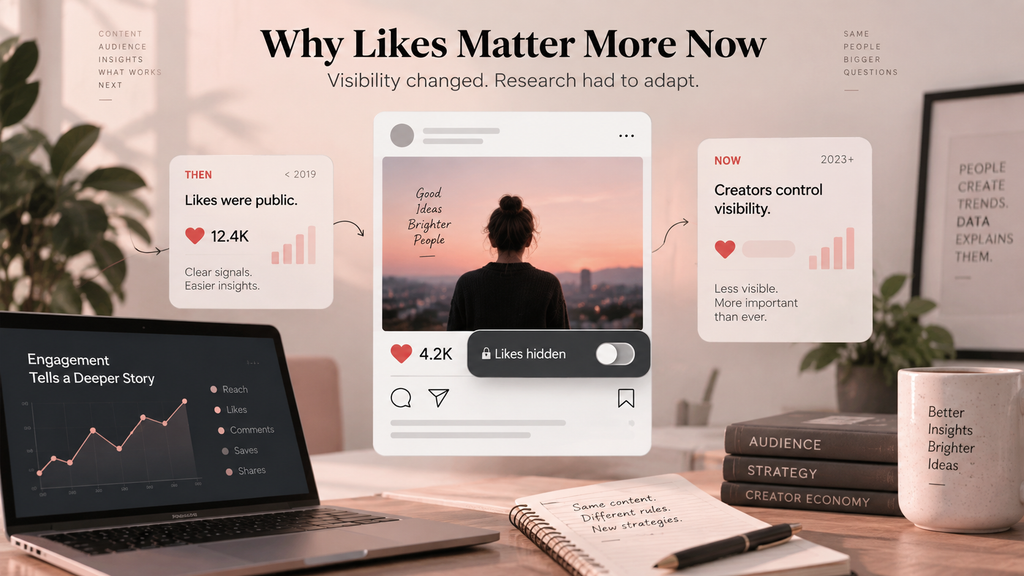
Instagram has spent the last several years quietly experimenting with like visibility. At different points, the platform tested hiding like counts from public view entirely, showing them only to the account owner, and rolling that test back for some regions while keeping it in others.
The result is a patchwork. What’s visible on one account, or even one post, doesn’t always match what’s visible on another, depending on settings the individual creator controls.
It’s worth noting this wasn’t framed publicly as a permanent decision at any point. Instagram described the early tests as an experiment aimed at reducing pressure around performance metrics, particularly for younger users comparing themselves against high-performing accounts.
Whatever the original intent, the practical effect for anyone doing outside research was the same. A metric that used to be reliably visible became something you’d need to check for, rather than something you could assume.
For anyone trying to read engagement from the outside, a blogger sizing up a potential collaborator, someone comparing how their own content performs against competitors, this inconsistency is the actual story. It’s not that likes stopped mattering. It’s that seeing them got less predictable.
That’s exactly why interest in a dedicated Instagram likes viewer has grown alongside the uncertainty. Search interest in this category has followed the same pattern almost every time Instagram adjusts a visibility setting, a spike in people looking for a workaround shortly after engagement becomes harder to read by default.
How Visibility Has Shifted
| Period | What Was Typically Visible | What This Meant for Outside Observers |
| Early Instagram | Like counts shown publicly by default | Engagement was easy to compare across accounts at a glance |
| Testing phase | Counts hidden from public view in several markets | Outside observers lost a quick way to gauge post performance |
| Current state | Creator-controlled visibility, inconsistent by account | Engagement reading now depends on individual settings, not a platform default |
That progression matters for content strategy in a way a single headline about “Instagram hiding likes” never quite captured. The reality was never a clean on-or-off switch. It became a setting, which means outside observers now need a different approach than just glancing at a post.
Why Bloggers Specifically Feel This
Bloggers rely on engagement signals more directly than casual users do. A few things depend on being able to see that data clearly:
- Deciding whether a creator is worth partnering with
- Sizing up which content formats are actually landing with an audience
- Benchmarking a client’s account against competitors
- Spotting early signs that a content shift is or isn’t working
When visibility became inconsistent, the workaround wasn’t to stop caring about likes. It was to find another way to check them, and that’s precisely the gap a well-built Instagram likes viewer fills for anyone doing this kind of work regularly.
That’s the practical reason an Instagram likes viewer has become part of a lot of bloggers’ actual workflow rather than a novelty tool. It’s less about curiosity and more about restoring a research capability that used to be built into the platform by default.
Losing that default visibility didn’t make the underlying question go away, how well is this content actually performing. It just made the question harder to answer without the right supporting tool.
What a Likes Viewer Actually Restores, and What It Doesn’t
An Instagram likes viewer, used properly, gives back a version of what public visibility used to provide by default. It’s a way to check engagement on content where the creator hasn’t hidden that number, without needing to follow the account or dig through settings yourself.
That’s a real, useful restoration of a research capability.
What it doesn’t do is override an individual creator’s choice to hide their own like count. If an account has genuinely turned that visibility off, no external tool changes that. The setting lives on Instagram’s side, not in whatever browser tool someone’s using to look.
Anyone treating a likes viewer as a way to see numbers a creator has deliberately hidden is working from a misunderstanding of how the feature functions, and that misunderstanding tends to produce disappointment rather than useful data.
Reading Engagement Beyond the Raw Number
Even where like counts are visible, treating that number as the whole story is a mistake a lot of newer bloggers make.
- Comment volume often tells a more honest story than likes alone, since comments require more effort and signal a stronger reaction
- Save counts, where visible, indicate content people found valuable enough to revisit
- Share activity, though harder to measure externally, often predicts reach better than likes ever did
The Instagram likes viewer conversation tends to focus narrowly on one number because it’s the most familiar one, the metric people have been trained to check first since Instagram’s early days. A genuinely useful read on engagement pulls in more than that single figure.
This isn’t a call to abandon likes as a metric. They still correlate reasonably well with immediate audience reaction, and a post with a strong like count relative to an account’s typical range is still a meaningful signal. The point is narrower: likes work best as one input among several, not as the single number a whole strategic decision gets built on.
Where This Is Heading
Platform-level engagement metrics have been trending toward more creator control for years now, not just on Instagram. Expect that pattern to continue rather than reverse.
The practical takeaway for bloggers isn’t to wait for visibility to become simple again. It’s to build a research process that doesn’t collapse the moment one number becomes harder to see.
That means treating tools like an Instagram likes viewer as one part of a broader toolkit rather than a single source of truth. Cross-referencing engagement signals where possible, and building relationships with creators that don’t depend entirely on external metrics, matters more than any single tool. The bloggers who adapt fastest to this shift tend to be the ones who stop treating any single number, likes included, as a complete picture of how well content is actually performing.
There’s also a practical argument for diversifying research methods beyond any one tool. A likes viewer that works well today might change how it functions, or stop working entirely, the same way individual sites in this broader category have come and gone before. Building a habit of checking engagement through more than one method, a viewer tool alongside direct observation of comments and reach where visible, means the workflow doesn’t collapse if any single piece of it changes.
The Bigger Pattern Worth Noticing
None of this is really about likes specifically. It’s about how platforms are gradually shifting engagement data from a public default to a creator-controlled setting, and what that means for anyone whose work depends on reading that data from the outside.
Likes happened to be first. Other metrics are likely to follow a similar path over time, which makes the adjustment bloggers are making right now, around how they use an Instagram likes viewer and similar tools, a skill worth building regardless of what Instagram does next.